History of Essaouira
The Origins of Mogador
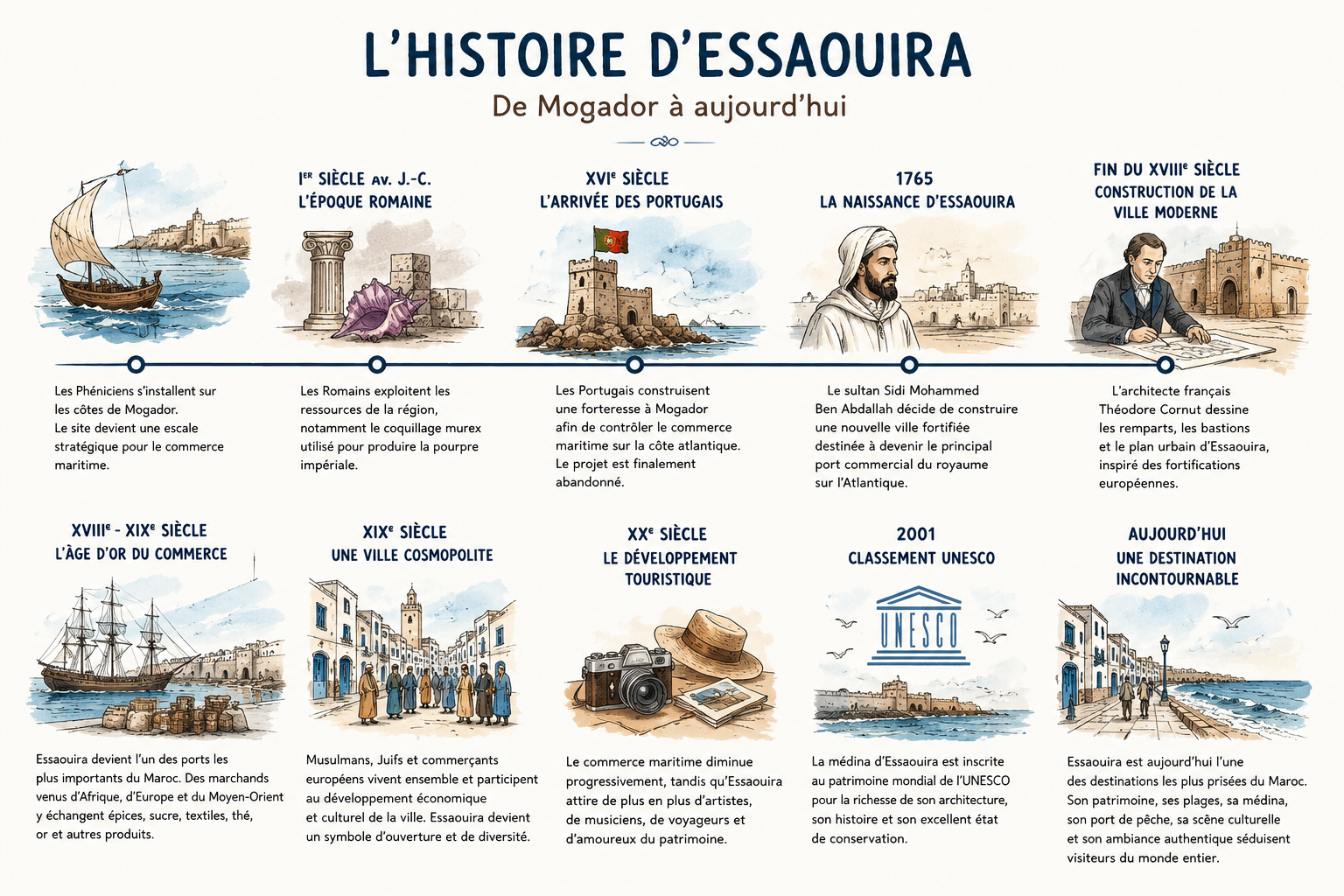
Behind the sandstone ramparts that defy the Atlantic Ocean lies one of Morocco's most captivating stories. The history of Essaouira is a succession of strategic eras, conquests, trade exchanges, and cultural blending. Through these ten major historical stages, discover how the small ancient trading post of Mogador became the Moroccan cultural gem it is today.
1. Antiquity and the Phoenician stopover
Long before becoming a fortified city, the bay of Essaouira attracted the greatest navigators of Antiquity. The Phoenicians were the first to settle along the coasts of Mogador. Drawn by the natural protection offered by the islands facing the shore, they transformed the site into a highly strategic stopover to secure and develop maritime trade between the Mediterranean Sea and the African coasts.
2. The 1st century BC: The Roman era and imperial purple
During the Roman era, the region took on an almost legendary dimension. Under the impetus of King Juba II, the Romans actively exploited the local natural resources. On the islands of the bay, they discovered an abundance of murex, a small sea shell. From this mollusk, they extracted an extremely rare and precious purplish-red dye: imperial purple, used to dye the togas of emperors and high dignitaries of Rome.
3. The 16th century: The arrival of the Portuguese and the coastal fortress
The 16th century marked a major military turning point for the site. Attracted by the bay's strategic geographical position, the Portuguese settled there and built an imposing fortress. Named Castelo Real, this structure was intended to control the maritime trade routes along the Moroccan Atlantic coast. Faced with local resistance, this military project was eventually abandoned, but its fortified foundations remain etched into the landscape.
4. 1765: The Sultan's vision and the birth of Essaouira
The year 1765 marks the true founding of the modern city. The powerful Alaouite Sultan Sidi Mohammed Ben Abdallah made the historic decision to build a new fortified city on the ruins of ancient Mogador. His ambition was clear: to give the kingdom its main commercial port open to the Atlantic Ocean, in order to centralize and tax trade with the European powers.
5. End of the 18th century: The construction of the modern city by Théodore Cornut
To bring his architectural dream to life, the Sultan called upon the famous French architect Théodore Cornut, a student of Vauban-style fortification methods. He designed a revolutionary city: he drew straight-lined plans inspired by European strongholds while integrating Moroccan craftsmanship and aesthetics. It was from this unique alliance that the monumental ramparts, defensive bastions, and the city's distinctive urban design were born, earning it the name Es-Saouira (“the well-designed one”).
6. 18th – 19th century: The golden age of international trade
Once fortified, Essaouira quickly established itself as one of Morocco's most important and influential ports. Nicknamed the port of Timbuktu, the city saw merchants from sub-Saharan Africa, Europe, and the Middle East pass through every day. Rare spices, sugar, fine textiles, tea, gold, and many other manufactured goods were traded at high prices, making the city a global economic hub.
7. The 19th century: A cosmopolitan city and a model of diversity
Fueled by this economic prosperity, Essaouira became a unique cultural melting pot within the Arab-Muslim world. Muslims, Jews, and European traders settled there permanently. These communities coexisted peacefully, side by side, actively contributing to the city's economic, architectural, and cultural development. Essaouira thus became the eternal symbol of openness, tolerance, and diversity.
8. The 20th century: Artistic awakening and tourism development
As maritime trade activities gradually declined in favor of larger ports such as Casablanca, Essaouira underwent a fascinating transformation throughout the 20th century. Its unique light, wind, and mystical atmosphere attracted more and more artists, musicians, filmmakers, and travelers from around the world. The city gradually traded its role as a trading port for that of a bohemian capital cherished by heritage lovers.
9. 2001: Recognition and UNESCO listing
The turn of the 21st century brought the city its most prestigious international recognition. In 2001, the medina of Essaouira was officially inscribed as a UNESCO World Heritage Site. This global recognition celebrated the exceptional richness of its blended architecture, the depth of its multicultural history, and the excellent state of preservation of its historic fortifications.
10. Today: An essential and timeless destination
Today, Essaouira stands as one of Morocco's most sought-after and endearing destinations. Far from having become a museum-city, it remains intensely alive. Visitors flock here to explore its vibrant medina, watch the blue trawlers dance in its fishing port, immerse themselves in its cultural and musical scene, or simply seek an authentic sweetness of life that continues to captivate travelers from around the world.
On WeTravelGo, you will find all the tips, recommended places, and practical information you need to plan your stay, discover must-see spots, and experience an authentic journey at the heart of one of Morocco's most beautiful cities.