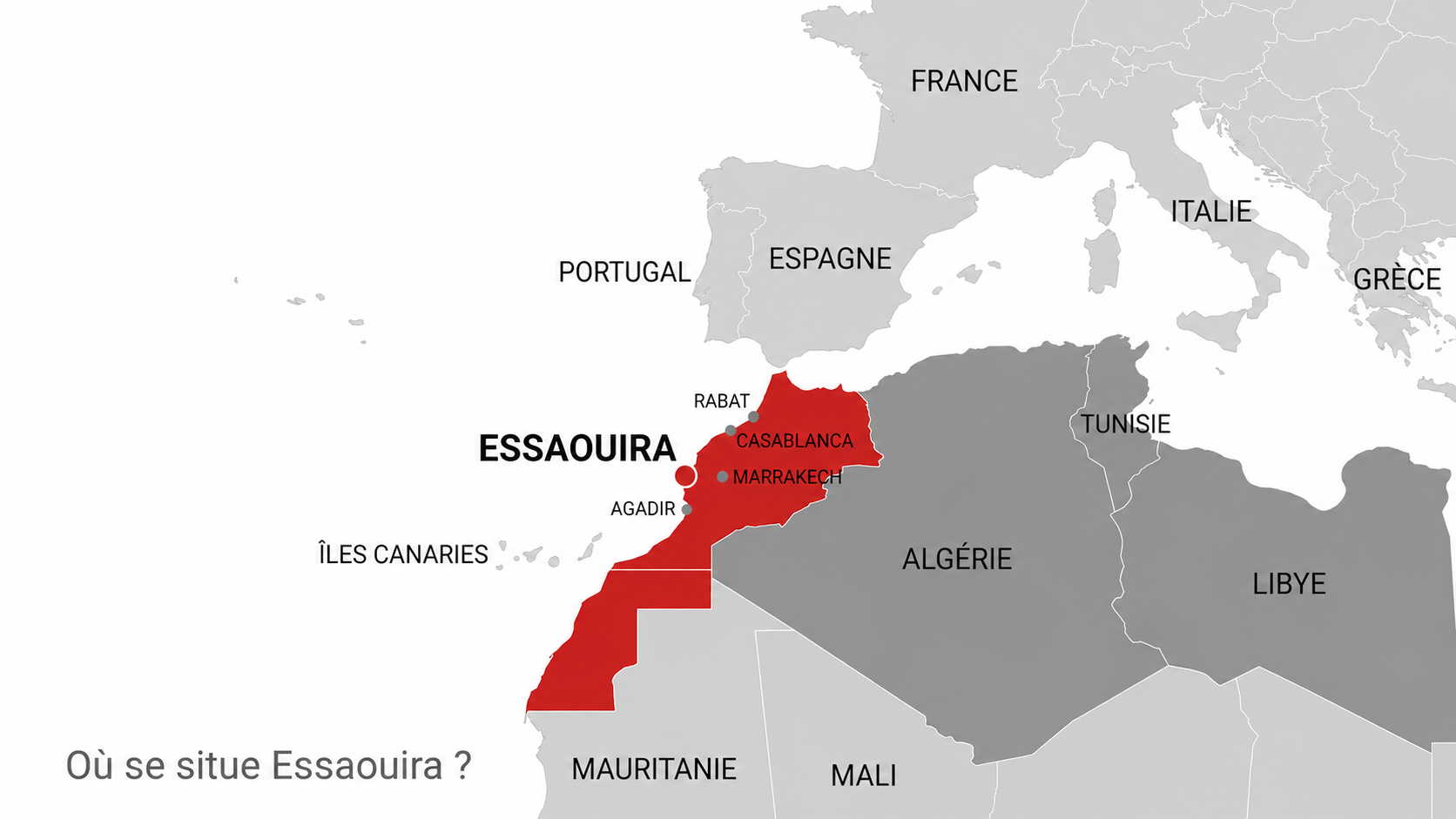
Where is Essaouira located?
A privileged position
On an international scale, Essaouira occupies a strategic position on the north-western façade of the African continent, facing directly onto the immensity of the Atlantic Ocean. Ideally located just a few hours' flight from the major European capitals, it represents a privileged gateway to southern Morocco. Within the kingdom's borders, the city is solidly anchored in the west-central part of the country, within the dynamic administrative region of Marrakech-Safi. Nestled about 190 kilometers west of the famous "Red City," Essaouira opens generously onto the coastline, offering a spectacular coastal landscape where vast fine-sand beaches, powerful waves, impressive dune ridges and a hilly hinterland planted with argan trees harmoniously come together. This varied geography makes it a destination of rare versatility, capable of appealing both to travelers seeking total disconnection and wild nature, and to enthusiasts of history, culture and architecture.
Optimal accessibility from Morocco's major urban centers
Thanks to a modern and constantly improving road network, Essaouira enjoys excellent connectivity with the major metropolises and other tourist hubs of Morocco. The city lies about 175 kilometers north of Agadir, the great seaside resort of the Souss, 370 kilometers south of Casablanca, the country's economic powerhouse, and nearly 470 kilometers from the administrative capital, Rabat. This relative geographic proximity and the smoothness of the road network make it very easy to plan stays of varying lengths, from a simple long weekend for Moroccan city-dwellers to much longer road-trip itineraries for international tours. The road linking Marrakech to Essaouira, which is particularly well maintained, can be covered in a little under three hours through arid landscapes that gradually give way to argan forests, offering a striking visual transition before arriving facing the ocean.
Here is an overview of the average distances and travel times to reach the city of Mogador:
Marrakech: about 190 km (2h30 to 3h drive), the most frequently used route by travelers.
Agadir: about 175 km (3h drive) via the coastal road offering superb views over the Atlantic.
Safi: about 130 km (2h drive) heading north along the coast.
Casablanca: about 370 km (4h30 to 5h drive) via the highway and expressways.
Rabat: about 470 km (5h30 to 6h drive) for travelers arriving from the capital.
The impact of geographic positioning on a unique temperate climate
Essaouira's geographic location gives it an exceptional climatic uniqueness on a Moroccan scale. While the interior of the country experiences intense heat waves during the summer season, with temperatures regularly exceeding 40°C in Marrakech, Essaouira acts as a true oasis of coolness thanks to the regulating influence of the Atlantic Ocean. The city is indeed swept almost permanently by trade winds, those regular sea breezes that maintain a mild and temperate climate throughout the year. This specific climatology shields the city from the harshness of winter and the heatwaves of summer, guaranteeing a constant sweetness of life. While this characteristic wind protects the city from the heat, it also delights the international community of water sports enthusiasts; Essaouira is world-renowned as one of the best spots on the Atlantic for surfing, kitesurfing, wingfoiling and sailing, attracting enthusiasts who come to test the quality of its waves and the consistency of its air currents.
A pivotal position for exploring a wild and unspoiled coastline
Beyond its own ramparts, Essaouira occupies a central and highly strategic position for all those wishing to explore the raw beauty of the Moroccan Atlantic coast. Radiating out just a few kilometers north or south of the medina, travelers discover a constellation of remarkable natural sites and small picturesque villages that have remained sheltered from mass tourism. A short drive away lies the famous village of Diabat, wrapped in its hippie legends and marked by the passage of Jimi Hendrix, as well as the endless beach of Sidi Kaouki, a true mecca for surfers and lovers of wild camping. Venturing a little further, the spectacular Cap Sim reveals its formations of shifting dunes plunging into the sea, while Moulay Bouzerktoun stands as the essential haunt of high-level windsurfers. Further south, the village of Tafedna unfolds a wild beach nestled in the hollow of the Atlas cliffs. These nearby stops offer a striking diversity of landscapes, considerably enriching a stay in Essaouira by combining the discovery of a historic city with the exploration of a totally unspoiled nature.
Diverse international and national access options
For travelers coming from abroad, access to this coastal enclave is greatly facilitated by the presence of Essaouira-Mogador International Airport (ESU), ideally located just about fifteen kilometers south of the city center. This human-scale airport benefits from regular direct connections with several major European metropolises, allowing travelers to land right at the gates of the medina without having to endure the long formalities of major national hubs. At the same time, a significant proportion of visitors strategically choose to land at Marrakech-Menara International Airport, which offers a higher volume of flights, before heading on to Essaouira. For this connecting journey, travelers have a multitude of options: car rental for total independence, shuttle and private transfer services for optimal comfort, or air-conditioned bus lines operated by trusted national companies, which provide reliable and economical daily connections. This plurality of access options reinforces the city's appeal, making it as easy to reach as it is pleasant to discover.
On WeTravelGo, you will find all the advice, good addresses and practical information to organize your stay, discover the must-see spots and experience an authentic journey at the heart of one of the most beautiful cities in Morocco.